























In commercial vehicle maintenance and aftermarket distribution, few components carry as high a cost-to-failure ratio as the wheel hub seal. While a hub seal represents a fraction of a wheel-end assembly’s cost, premature seal failure leads directly to lubricant loss, tapered roller bearing seizure, brake lining contamination, and costly roadside downtime—often resulting in Out-of-Service (OOS) violations during DOT or European roadside inspections.
For parts importers, regional wholesalers, and fleet procurement managers serving the Americas and Europe, sourcing the right hub seal requires more than matching an outer diameter. Variations in axle load, braking systems (disc vs. drum), and lubrication media (grease vs. oil-bath) dictate strict material and structural requirements.
This technical guide breaks down how to select the correct heavy-duty hub seal, compare elastomer materials, and accurately cross-reference European OEM part numbers.
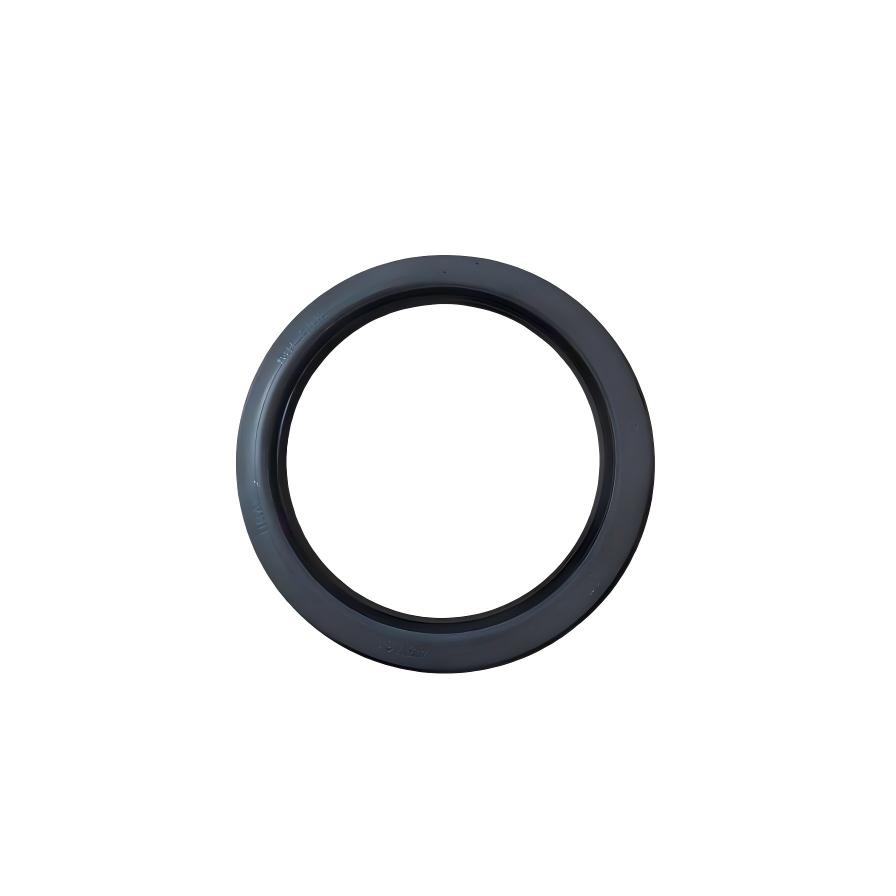
1.Structural Design: Standard Lip Seals vs. Cassette Seals
Understanding the mechanical architecture of the seal is the first step in preventing premature returns from repair workshops.
- Standard Radial Shaft Seals (Single/Double Lip): These consist of a metal outer case, a primary sealing lip with a garter spring, and often a secondary dust lip. While economical, the sealing lip rides directly on the axle spindle or hub surface. Over time, friction wears a groove into the spindle journal, requiring costly machining or a repair sleeve during replacement.
- Cassette Hub Seals (Unitized Seals): Widely adopted as the standard by European axle manufacturers such as BPW, SAF-Holland, and Meritor, as well as OEMs like MAN, Mercedes-Benz, Volvo, and Scania, cassette seals are self-contained, multi-lip labyrinth units.
How they work: The sealing lip rotates against an integrated, precision-ground inner wear sleeve rather than the axle spindle itself.
Key Advantage: Multiple axial and radial labyrinth barriers block mud, water, and brake dust from reaching the primary sealing lip, significantly extending service intervals
—often exceeding 500,000 km in long-haul applications.
Procurement Tip: Never downgrade a wheel-end specified for a cassette seal to a standard single-lip seal, even if the inner diameter (ID), outer diameter (OD), and width (H) match. Standard seals lack the multi-stage contamination exclusion required for modern European hub units.
2.Material Selection: NBR vs. FKM (Viton®)
Choosing the wrong elastomer is the primary cause of hardened, cracked, or swollen seals in the field. When sourcing aftermarket or OEM hub seals, always verify the base polymer against the vehicle’s braking system and lubricant type.
| Technical Parameter | NBR (Nitrile Butadiene Rubber) | FKM / FPM (Fluoroelastomer / Viton®) |
| Operating Temperature | -40°C to +100°C (-40°F to +212°F) | -20°C to +200°C (-4°F to +392°F) |
| Recommended Brake Type | Drum Brakes (Lower heat transfer to hub) | Disc Brakes (High thermal load during braking) |
| Lubricant Compatibility | Standard mineral greases & gear oils | Synthetic gear oils, EP additives & high-temp greases |
| Chemical & Ozone Resistance | Moderate | Superior (Resists aggressive synthetic oil additives) |
| Typical Application | Regional haul, standard trailers, older axles | Long-haul tractors, heavy-duty trailers, oil-bath hubs |
Why Disc Brakes Demand FKM Seals
Modern European commercial vehicles overwhelmingly utilize air disc brakes (such as Knorr-Bremse and WABCO systems). Because the brake rotor is mounted directly to the wheel hub, heavy braking generates intense radiant heat that transfers straight into the hub cavity. Under sustained temperatures above 110°C, standard NBR lips vulcanize, lose elasticity, and crack. Always specify FKM seals for disc-brake axles and oil-bath hubs.
3.OEM Compatibility & Cross-Reference Verification
In cross-border parts trading, cross-referencing errors happen when buyers rely solely on incomplete catalog conversions. To guarantee 100% fitment across European and American fleets, verify three data points before placing a bulk order:
Ⅰ.Exact Dimensional Triplet ($ID\timesOD\times H$): Confirm the inner diameter, outer diameter, and overall axial height in millimeters. Note that for cassette seals, the inner ring width may differ slightly from the outer casing width—always check both dimensions.
Ⅱ.OEM & Tier-1 Part Numbers: European truck manufacturers source their wheel-end bearings and seals from Tier-1 engineering leaders—most notably FAG and INA (Schaeffler Group), alongside Corteco and SKF. In many cases, the FAG wheel hub repair kit or standalone cassette seal is identical to the genuine truck OEM part, differing only in packaging.
Ⅲ.ABS Integration: Many modern European wheel hub units integrate a magnetic encoder ring or ABS pole wheel directly into the seal or bearing assembly. Replacing a sensor-integrated seal with a standard non-magnetic seal will immediately trigger an EBS/ABS fault code on the dashboard.
Common European Axle & Hub Seal Applications
BPW Axles (Eco / Eco Plus / Eco Plus 2): Require specific multi-lip cassette seals engineered for high-load trailer hubs.
SAF-Holland Axles (SKRS / Intradisc): Utilize precision unitized seals designed to work in tandem with compact tapered roller bearing units.
Volvo / Scania / MAN / Mercedes-Benz: Front and rear drive axles rely heavily on FKM cassette seals paired with FAG/INA wheel bearing sets to maintain strict axial end-play tolerances.
4.How to Source Genuine European Hub Seals Without Supply Chain Risk
For independent wholesalers and fleet buyers in North America, Latin America, and Europe, sourcing genuine European parts often presents two challenges: high minimum order quantities (MOQs) from regional master distributors, and the risk of counterfeit packaging in the open market.
At www.smart-vehicle.cn, we operate as an independent global reseller specializing in authentic European commercial vehicle components—including FAG, INA, WABCO, Knorr-Bremse, and ZF.
- 100% Genuine OEM & Tier-1 Sourcing: Every hub seal and wheel bearing kit we supply is sourced through verified European supply channels, featuring original factory packaging, batch codes, and laser-etched part markings for complete traceability.
- Multi-Brand Consolidated Shipments: Instead of managing separate suppliers and freight forwarders, you can consolidate FAG/INA wheel hub seals and bearings with WABCO/Knorr-Bremse braking valves and ZF transmission parts into a single air or sea shipment.
- Fast Technical Cross-Referencing: Unsure whether a customer’s OE number requires an NBR or FKM specification? Our technical sales team verifies dimensions, axle models, and Tier-1 equivalents before quoting.
Need a Quote or OEM Cross-Reference Check?
Send us your OEM part numbers (BPW, SAF, MAN, Volvo, Scania, Mercedes-Benz) or FAG / INA / Corteco reference list today. Our team will respond with real-time stock availability, competitive export pricing, and shipping options to your port or warehouse.
Instant WhatsApp Desk: [Click here to message our Parts Specialists on WhatsApp: +8618003718313 (Fastest response for urgent part number checks)
Bulk RFQ & Export Inquiries: Email your Excel/PDF inquiry list directly to [email protected] for a formal quotation within 24 hours.