























Anyone who has worked a parts counter or managed a heavy-duty repair bay knows that replacing a WABCO ABS ECU is rarely a “match-the-shape-and-bolt-it-on” job. Two control units can share the exact same cast aluminum housing and DIN bayonet plugs while running completely different internal circuit boards, CAN-bus protocols, or operating voltages.
In cross-border parts trading, ordering off a blurry OEM cross-reference—or forgetting to verify whether a unit requires End-of-Line (EOL) programming—is the fastest way to end up with a dead-on-arrival return claim or a truck stuck in limp mode with a permanent ABS warning lamp.
Drawing from real-world order verification across North American, Latin American, and European fleets, here is how to decode WABCO numbers, avoid fatal voltage mismatches, and get the software configuration right the first time.
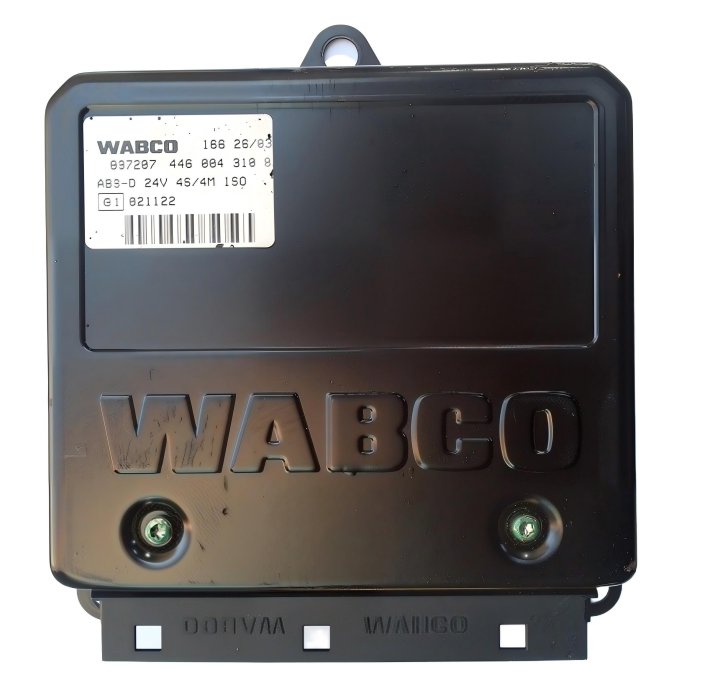
Ⅰ.Decoding the 10-Digit WABCO Part Number (And Why the Last Digit Matters)
Every genuine WABCO unit carries a 10-digit part number laser-etched or printed on its data plate (for example, 446 004 605 0 or 400 500 101 0). When sourcing replacements, the vehicle OEM number alone often maps to multiple WABCO supersessions depending on the chassis VIN. Always pull the 10-digit WABCO code directly off the unit.
First 3 Digits (Product Group):
- 446 xxx xxx x: Cab- or frame-mounted electronic control units for trucks and buses (ABS D/E-Version, EBS, ECAS).
- 400 500 xxx x: Trailer ABS control units and integrated ECU-valve assemblies (VCS and VCS II).
- 480 102 xxx x: Trailer EBS (TEBS E) modulators.
Middle 6 Digits (Hardware & Firmware Variant): This block defines the exact pinout, sensor/modulator channel layout (such as 4S/4M vs. 6S/6M), and factory communication protocol (J1939 vs. ISO 11992). Even a single-digit change in the middle six numbers means the internal PCB layout or pre-loaded flash file is different.
Last Digit (Packaging & Supply Channel):
- 0: Brand-new OEM/aftermarket unit in standard individual packaging.
- 7: Factory-remanufactured unit (WABCO Reman—typically subject to core charges in domestic markets, though exported outright in international trade).
- 2: OE factory-direct / bulk packaging variant (originally supplied in multi-pack trays to vehicle assembly lines without individual aftermarket retail boxes).
Counter Tip: Never substitute one 446 004 series box for another just because the 15-pin or 18-pin plug clicks into place. A unit built for a Scania 24V chassis will not talk to a Freightliner J1939 network, even if the harness physically mates.
Ⅱ.Truck (D/E-Version) vs. Trailer Systems: Getting 12V and 24V Right
A common mistake when buyers source across both American and European fleets is mixing up trailer ABS generations and operating voltages.
| System Series | Common Part Prefixes | Primary Fleet Application | Architecture & Mounting | Operating Voltage |
| Truck ABS D-Version | 446 004 3xx 0 / 4xx 0 | Older Heavy/Medium Trucks & Buses | Cab-mounted; drives separate modulator valves (472 195 …) | 12V or 24V (Variant-specific) |
| Truck ABS E-Version | 446 004 6xx 0 / 446 135 … | Modern Trucks & Buses (J1939 CAN) | Cab or frame-mounted; supports ATC traction control | 12V or 24V (Variant-specific) |
| Trailer VCS | 400 500 070 0 / 081 0 | Legacy European & Global Trailers | Integrated ECU + Relay Valve assembly | 24V (Primary European spec) |
| Trailer VCS II | 400 500 101 0 / 102 0 / 103 0 | North American Semi-Trailers | Compact integrated ECU + Relay Valve (IP6K9K) | 12V Only |
| Trailer TEBS E | 480 102 030 0 / 060 0 | Modern European & LatAm Trailers | Integrated EBS modulator with roll stability (RSS) | 24V Only |
The 12V vs. 24V Trap
- VCS II (400 500 101 0 through 104 0) is strictly a 12V platform engineered for the North American trailer market.
- European and Latin American Euro-spec trailers (running behind Volvo, Scania, MAN, or Mercedes-Benz tractors) run on 24V, using legacy 24V VCS units or modern 24V TEBS E modulators.
- Feeding 24V power into a 12V VCS II board will fry the internal voltage regulators the second the ignition key turns. Always verify the voltage stamp on the housing before powering up.
Ⅲ.Channel Layouts (S/M) and Connector Interfaces
Before locking in a purchase order, verify the axle setup:
- 2S/2M & 4S/2M: Standard trailer layouts (2 or 4 wheel speed sensors feeding 2 modulator channels).
- 4S/4M: Standard 4×2 tractor/rigid setup with independent wheel-by-wheel control.
- 6S/6M: Heavy 6×4 tractors and tandem-axle trucks requiring individual modulation across front and dual rear axles.
Check the plug style at the same time: cab-mounted D/E boxes use multi-pin DIN or AMP connectors, while chassis-mounted VCS II and TEBS E units rely on heavy-duty bayonet-locking plugs (ISO 7638 power, sensor, and modulator ports) with rubber seals designed to survive high-pressure washdowns and road salt.
Ⅳ.Software Parameters (EOL): Is It Plug-and-Play or Does It Need Programming?
Workshops frequently bench-test or install a brand-new WABCO ECU, see the ABS light stay on, and assume the unit is defective. In reality, whether an ECU is ready out of the box comes down to how that specific part number was provisioned:
- OE-Specific Part Numbers (Pre-Flashed): If you buy the exact 10-digit WABCO number assigned to a specific truck builder, the End-of-Line (EOL) parameter file is already loaded. Once bolted in, you simply clear stored fault codes and drive the vehicle above 15–20 km/h so the ECU can self-learn the tire rolling circumference.
- Universal Aftermarket Service Units (Blank/Base Firmware): Many generic replacement numbers—especially universal VCS II service units—ship with baseline firmware only. Before the warning lamp clears, a technician must connect WABCO Toolbox or WABCO System Diagnostics (WSD) via a DI-2 interface and flash the vehicle parameters:
- Sensor and modulator configuration (e.g., 2S/2M vs. 4S/2M).
- Pole wheel tooth count (100 teeth on standard heavy-duty hubs).
- Tire size / rolling circumference and blink-code / CAN-bus settings.
Shop Floor Rule: Never hot-plug an ABS ECU with the battery connected, and always unplug all ECU harnesses before doing any arc welding on the truck or trailer frame. Stray weld current will wipe out the ECU’s internal drivers instantly.
Ⅴ.Sourcing Genuine WABCO Electronics Without Counterfeit Risk
In the heavy-duty aftermarket, copied or poorly re-cased ABS ECUs are a major liability—a faulty internal relay or dropped CAN signal can lock up trailer axles or disable traction control in wet conditions.
At www.smart-vehicle.cn, we operate as an independent global reseller supplying 100% genuine WABCO, Knorr-Bremse, ZF, FAG, and INA parts to wholesalers, importers, and fleet workshops across the Americas and Europe.
- Authentic Factory Stock: All WABCO electronics ship in original factory packaging with intact batch labels and verifiable laser-etched housings—zero unbranded clones or questionable rebuilds.
- Consolidated Air & Wheel-End Orders: Bundle your WABCO ABS ECUs with modulator valves (472 195 …), wheel speed sensors (441 032 …), Knorr-Bremse air valves, and FAG/INA hub bearings into a single export shipment to cut freight and customs clearance costs.
- Pre-Shipment Number & Voltage Audit: We verify 10-digit supersessions, 12V/24V specs, and plug configurations before packing your order.
Get Fast Verification & Export Pricing (Wholesale Lists or Nameplate Photos)
Whether you are restocking your warehouse or troubleshooting a single vehicle in the bay, our parts team can cross-reference and quote your WABCO requirements quickly:
- For Workshops & Fleet Managers (Instant Nameplate Check): Snap a clear photo of the existing WABCO ECU data plate (showing the 10-digit number and voltage) and message us directly on WhatsApp:+8618003718313 for immediate part verification and stock status.
- For Importers & Wholesalers (Bulk RFQ): Send your Excel or PDF part number list to [email protected] to receive a formal export quotation, lead times, and consolidated air/sea shipping options within 24 hours.