
























Description
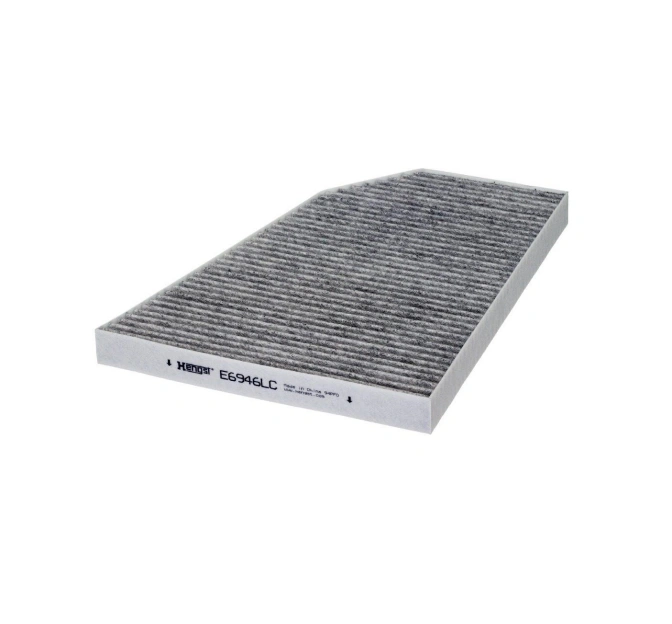
Engineered to provide a clean, allergen-free interior environment, the Hengst Activated Carbon Cabin Air Filter (Blue.care / Activated Carbon series) delivers high-efficiency filtration against airborne particulate matter, hazardous gases, and unpleasant odors. Modern vehicle HVAC systems continuously draw outside air directly into the cabin, exposing passengers to fine dust ($PM_{2.5}$), pollen, brake dust, industrial smog, and harmful exhaust gases such as nitrogen oxides ($NO_x$), ozone ($O_3$), and volatile organic compounds (VOCs). Featuring a multi-layer design that combines a synthetic microfiber non-woven pre-filter layer with a dense matrix of high-porosity coconut-shell activated carbon, Hengst cabin filters achieve exceptional gas-adsorption and particulate-capture rates. Designed to fit precisely inside OEM climate control housings, this filter prevents dust buildup inside the HVAC evaporator, reduces fogging on interior windshield glass, and ensures unrestricted airflow for optimal heating and air-conditioning efficiency. It is an essential, high-demand replacement part for automotive parts distributors, service chains, and commercial fleet managers worldwide.
Technical Parameters
| Category | Specifications & Technical Details |
| Multi-Layer Non-Woven Synthetic Media & PM2.5 Capture | Utilizes a combination of progressive fine non-woven fiber pre-filtration layer and electrostatic adsorption layer. Physical interception efficiency for fine particulate matter larger than 2.5 μm (such as PM2.5, pollen, brake dust, pollen allergens, and road dust) reaches over 95%, safeguarding in-cabin respiratory health. |
| High-Surface Area Coconut-Shell Activated Carbon Layer | Built-in high-quality granular activated carbon adsorption layer with a specific surface area exceeding 1,000 m²/g. Rapidly neutralizes nitrogen oxides (NOx), sulfur dioxide (SO₂), ozone (O₃), and harmful volatile organic compounds (VOCs) such as formaldehyde and benzene series, as well as odors, through physical and chemical adsorption. |
| Low Pressure Drop & Optimal Airflow Retention | Utilizes patented pleating and embossing technology to maximize filtration area while controlling initial airflow resistance at an extremely low level (pressure drop less than 100 Pa at rated airflow). Ensures strong air conditioning outlet airflow, prevents air conditioning blower overload, and shortens window defogging time. |
| Anti-Microbial & Anti-Fungal Treatment | The filter media undergoes safe biological antibacterial coating treatment, effectively inhibiting the growth and reproduction of bacteria, mold, and fungal spores on the filter surface under high-humidity environments (such as plum rain season or summer air conditioning condensate evaporation), eliminating musty and sour odors at the source when the air conditioning is turned on. |
| Precision Dimensions & Flexible Foam Sealing Frame | The filter element frame uses high-elasticity non-woven fabric or flexible foam sealing strip, featuring extremely high dimensional precision and anti-distortion stability. During installation and vehicle vibration, it tightly fits the air conditioning filter housing slot, completely eliminating unfiltered air “bypass” leakage into the cabin through edge gaps. |
Applicable Car Brands & Models
A standard particulate cabin filter uses paper or non-woven fiber to physically trap solid dust, pollen, and debris. An activated carbon cabin filter adds a specialized layer of porous carbon granules that chemically adsorb invisible harmful gases, smog, industrial pollution, and foul odors (such as exhaust fumes or ozone) that standard filters cannot catch.
Hengst recommends replacing the cabin air filter every 12,000 to 15,000 miles (15,000 to 25,000 km) or at least once a year. However, if you frequently drive in heavily polluted cities, dusty rural roads, or notice reduced heater/AC airflow and persistent unpleasent odors, replacement should be performed earlier.
Typical indicators include:
Reduced airflow from the dashboard climate control vents.
Persistent musty, damp, or dusty odors inside the car when the AC or heater is turned on.
Increased dust accumulation on dashboard surfaces.
Windows and windshield fogging up faster and taking significantly longer to clear.
Hengst cabin air filters are individually packaged in moisture-proof sealed plastic bags and encased in sturdy branded cardboard boxes to prevent activated carbon moisture absorption prior to installation. Export master cartons contain 10 to 30 individual units. Wholesale export MOQs start from 50 to 100 units per part number, with flexible shipping options available for mixed-part distributor orders.