
























Description
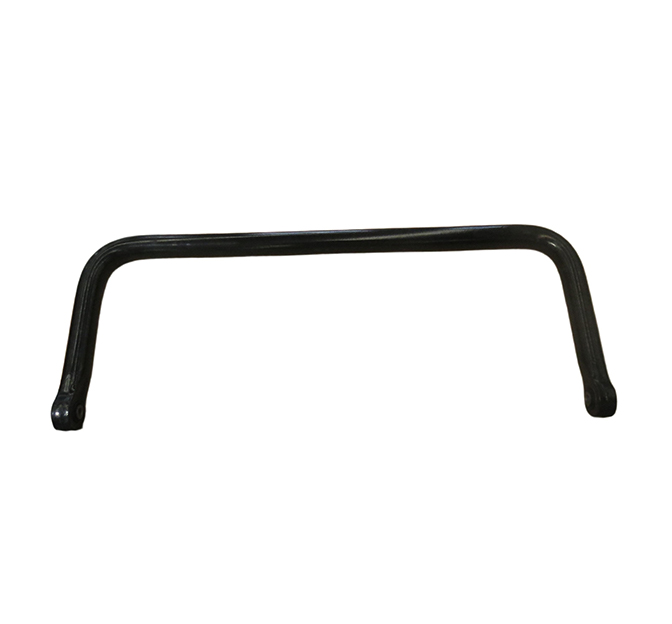
Eliminate dangerous body roll and maximize load stability on your commercial truck or fleet vehicle with the Heavy Duty Stabilizer Anti-Roll Bar. Engineered to interconnect opposing suspension wheels, this high-torsion stabilizer bar resists lateral centrifugal forces during sharp turns and heavy cargo shifts, keeping your commercial vehicle flat and controlled. Severe overloading, high-center-of-gravity freight, and rough road conditions eventually fatigue standard sway bars, causing excessive body lean and diminished steering response. This heavy-duty replacement anti-roll bar solves those problems directly. It utilizes spring-grade alloy steel, precision induction heat treatment, and high-fatigue shot-peened surfaces to deliver rock-solid cornering stability, eliminate chassis sway, and withstand severe commercial transport abuse.
Technical Parameters
| Category | Specifications & Technical Details |
| Spring-Grade Alloy Steel Composition | We hot-roll the bar from high-purity premium spring steel (such as 51CrV4 / SUP9). It delivers an extremely high elastic limit and yield strength, maintaining permanent elastic memory without permanent plastic deformation under high-load roll torsion. |
| Induction Heat Treatment & Through-Hardened Core | The bar passes precision CNC induction heating and combined quench-temper treatment. This process gives the bar surface extremely high wear-resistant hardness while the core retains strong shear toughness, completely preventing brittle fracture. |
| High-Fatigue Shot-Peening Surface Strengthening | We high-energy shot-peen the entire bar surface with high-speed steel shot. This creates a uniform residual compressive stress field on the surface layer, multiplying fatigue fracture life against high-frequency alternating road stress. |
| OE-Grade Precision Bending & Geometric Alignment | We use 3D CNC tube bending and laser positioning fixtures during forming. This ensures the mounting eyes achieve 100% perfect coaxial alignment with the original vehicle frame and stabilizer bushings, eliminating stress offset loading. |
| Industrial Multi-Layer Electrophoretic & Anti-Chip Coating | The surface carries a high-adhesion electrophoretic primer (E-Coating) and a weather-resistant anti-chip topcoat. This combination fully resists peeling and structural rust caused by de-icing salt, mud, rain, and road debris impact. |
Applicable Car Brands & Models
Common warning symptoms include:
Excessive Body Roll (Leaning): The truck or commercial vehicle feels heavily top-heavy, leaning dangerously to one side when negotiating highway off-ramps or sharp turns.
Visible Cracks, Bending, or Fractures: Physical deformation, stress cracks, or complete structural snapping of the steel bar body during routine maintenance inspections.
Clunking or Metal-on-Metal Noises: Sharp clunking sounds originating from the chassis when the suspension articulates over uneven pavement.
Loose or Unresponsive Steering Feel: The vehicle exhibits vague handling and delayed response during directional changes due to lost roll stiffness.
No, welding a broken or cracked stabilizer anti-roll bar is strictly not recommended. Because anti-roll bars are made of high-stress spring steel subjected to constant torsional twisting, welding alters the metallurgical properties, ruins the heat treatment, and results in immediate re-fracture under load. Replacement is mandatory.
Yes, absolutely. Worn rubber bushings and loose link joints allow unwanted play before the anti-roll bar can engage. Installing fresh high-durometer bushings and links alongside the new anti-roll bar ensures full hydraulic and mechanical efficiency of the roll-control system.
Due to its specialized shape and length, each anti-roll bar is coated with anti-rust inhibitor, wrapped in heavy-duty protective bubble barrier film, and secured inside a reinforced industrial corrugated box or custom wooden crating to prevent bending or coating damage during global freight transport.